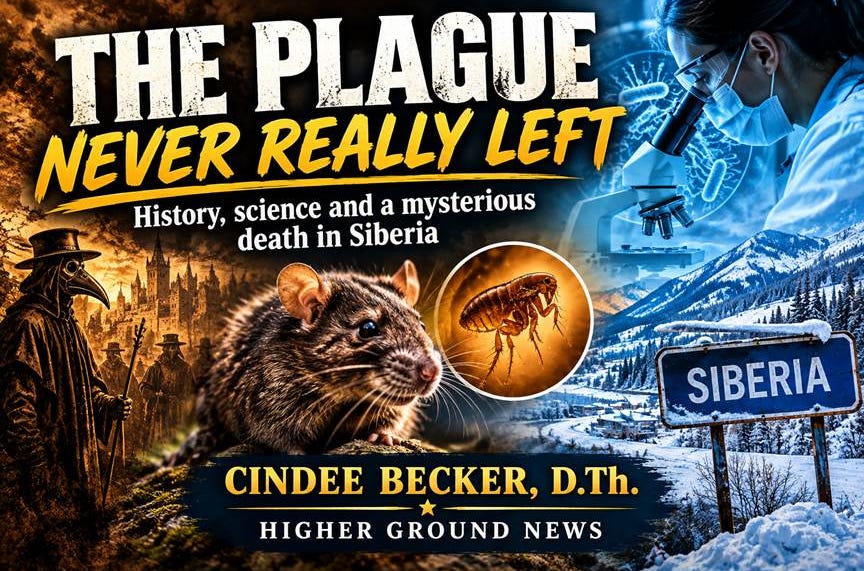
You may have seen the X post circulating about a mysterious death at a plague research facility in Siberia.
A 28-year-old laboratory worker dies after developing pneumonia, and suddenly roughly 200 people who may have had contact with her are being monitored.
But before we jump to conclusions, there is an important fact to know:
The plague has not been confirmed as the cause of her death. Russian officials have described her illness as pneumonia of unknown origin, and authorities say they found no signs of a laboratory accident involving pathogens.
Source: Reuters — Dozens quarantined in Siberia after plague institute lab worker dies
But here’s where this story gets really interesting.
Plague isn’t just something that happened during the Middle Ages.
Researchers recently found evidence that plague was already killing people around Lake Baikal in Siberia approximately 5,500 years ago. Ancient DNA from human remains showed Yersinia pestis, the bacterium responsible for plague, in two phases of prehistoric outbreaks.
Source: Nature — Lethal plague outbreaks in Lake Baikal hunter-gatherers 5,500 years ago
That means the region making headlines today was already dealing with plague thousands of years before the Black Death.
And eventually, this ancient disease became one of the greatest killers in human history.
The Black Death swept across Europe in the 14th century, killing more than 50 million people in Europe, according to the World Health Organization.
Source: World Health Organization — Plague
But here’s the part we sometimes forget: the plague never actually disappeared.
Yersinia pestis still circulates in animal populations and their fleas today. Human cases are rare, and modern antibiotics can successfully treat plague when it is recognized and treated early.
Source: World Health Organization — Plague
So what does this have to do with the X post?
Is plague actually back in Siberia? We don’t know yet.
And that’s precisely why I think this story is worth watching—not because we should panic, but because it is a remarkable reminder of how long some diseases have been with us.
Five thousand years ago, people living around Lake Baikal were dealing with the same bacterium. Centuries later, the Black Death changed the course of European history. Today, we have antibiotics, modern laboratories and vastly better medical knowledge.
But the organism itself? It’s still here.
And then there is the bigger question.
Some people are already asking whether stories like this fit into a larger “depopulation agenda.”
Right now, there is no evidence connecting this Siberian death to an intentional depopulation program—and I don’t think suspicion should be presented as fact.
But questions about who controls dangerous pathogens, who decides when a public-health emergency exists, and how much information the public receives are legitimate questions regardless of what ultimately caused one woman’s death.
The key is keeping the questions separate from the conclusions.
Because sometimes the most important part of a story isn’t what we know yet. It’s what we should be paying attention to.
The plague may be ancient. But our questions about power, fear and who controls the response to a crisis are not.
Until next time….
Don’t forget to like, comment, restack and share