

September 20, 2026
“The first to present his case seems right, till another comes forward and questions him.”
Proverbs 18:17
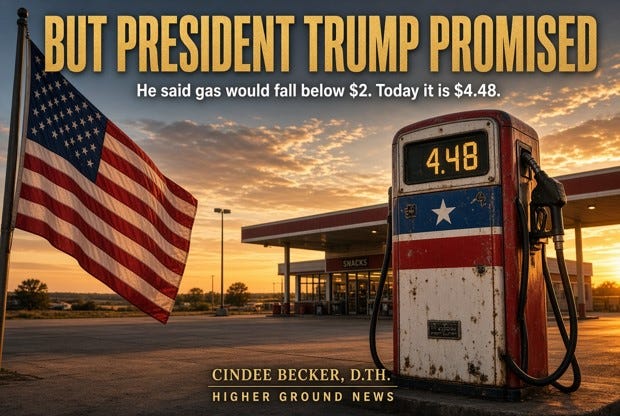
Many Americans are currently disillusioned and angry with President Trump for the price of gas at the pump. That is happening in line at the station. It is happening online. The national average is $4.48 a gallon. You hear it said over and over that he broke his promise to “We The People”. Hostilities and tensions continue; and the high price of gasoline keeps going up. This article examines those concerns through a factual lens.
The goal is not to defend or attack,
but to present what can be documented
and what remains unverifiable.
“The first to present his case seems right,
till another comes forward and questions him.”
Proverbs 18:17
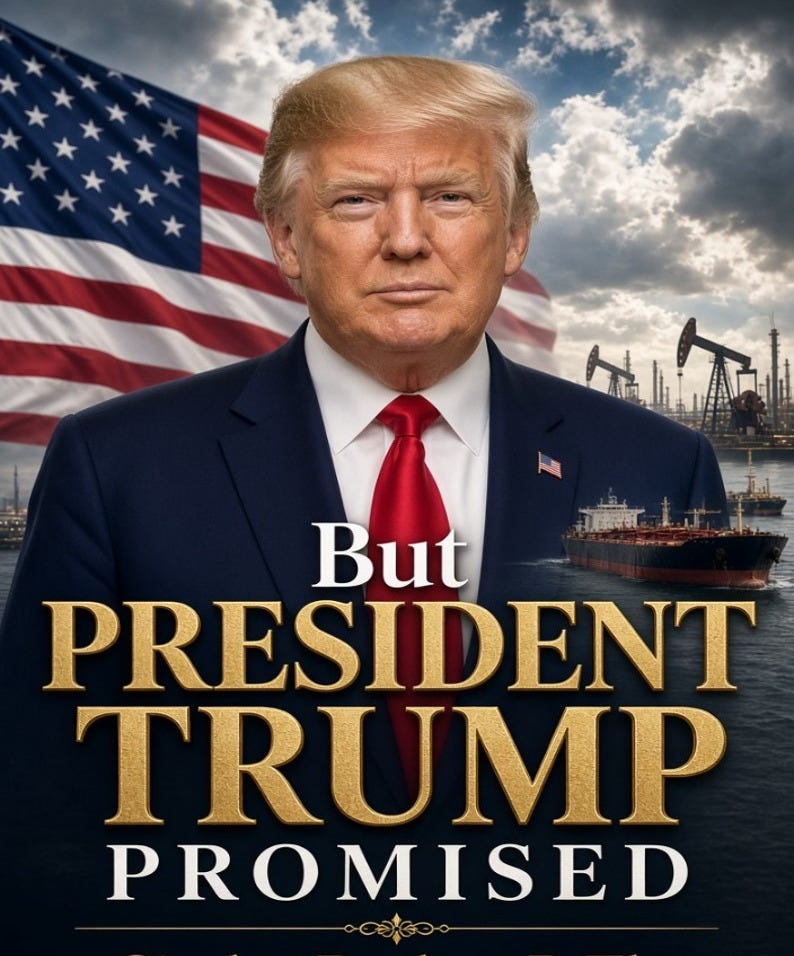
“We’re going down and getting gasoline below $2 a gallon.”
Donald Trump, Economic Club of New York, September 5, 2024
A lot of people think a president can just order gas prices down.
He cannot. He has no control over the price at the pump. He does not own the oil. He does not run the refineries. He does not set the price at your station.
Presidents do not set the world oil price by themselves. Saudi Arabia, Russia, and other oil producers affect it. Refineries affect it. State gas taxes affect it. Storms affect it. How much people drive affects it. A war that threatens shipping through the Strait of Hormuz affects it. That was true when Joe Biden was president. It is true now.
What is different is the promise. He said gasoline would go below $2 a gallon. Today it is $4.48. He said energy costs would be cut in half. That did not happen either.
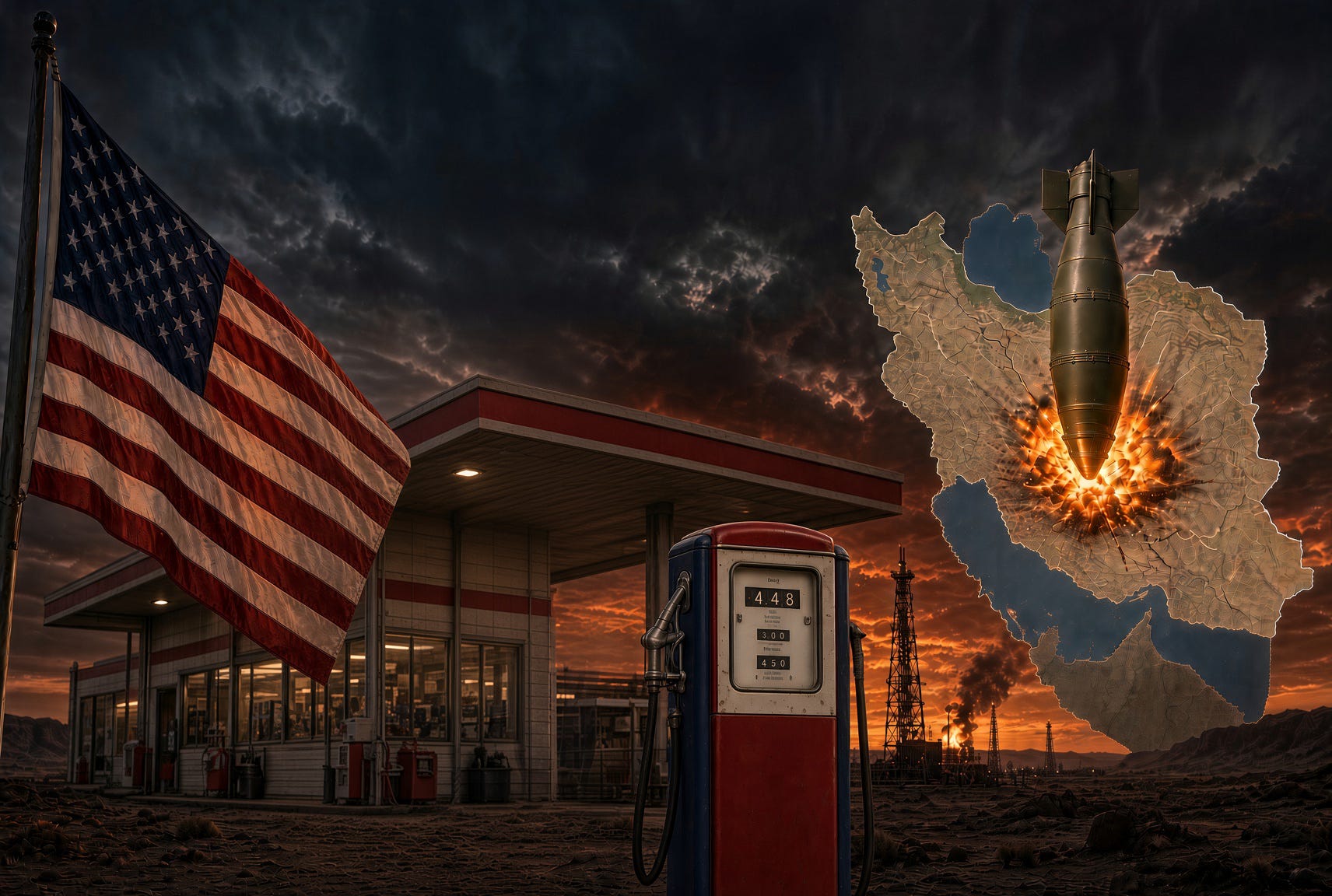
This Did Not Start At The Gas Pump. It Started With The Bomb.
So Ask The Questions:
Do you believe Iran already has nuclear bombs? If they do, why have they not used them? Their supreme leader is dead. Other leaders are dead. The country has been pulverized.
This is a regime whose slogan is Death to America. It calls the United States the Great Satan. If the mission is to destroy this country, and if they had a working nuclear weapon, why has that weapon not been used?
They did not use a nuclear bomb. They fired on ships in the Strait of Hormuz instead.
Which Would You Rather Have?
Would you rather pay more at the pump for a time while the United States fights to keep that waterway open? Or would you rather let Iran decide who gets Middle East oil?
Would you rather see a president use force against a regime that chants “Death to America,” arms proxies, and treats the strait like a weapon? Or would you rather keep sending frozen Iranian money and calling it peace while that same regime keeps the chant?
How The Fight Started
The June 2025 Strike and the Question of Verification
The United States entered the campaign directly on the night of June 21–22, 2025 (U.S. Eastern time).
Operation Midnight Hammer

In a single coordinated operation—Operation Midnight Hammer—U.S. forces struck Iran’s three primary nuclear enrichment and conversion facilities at Fordow, Natanz, and Isfahan with the heaviest penetrator weapons available.
That one-night strike is the moment Iran’s ability to produce enriched uranium at industrial scale was severely damaged under the Trump administration.
Iran Has Blocked Proper Independent Access
Because Iran has blocked proper independent access, the International Atomic Energy Agency lost continuity of knowledge over the key sites.
Without physical inspection of the enrichment halls, centrifuges, and the remaining stockpile of highly enriched uranium, no outside party can produce a verified damage assessment.
All claims about residual capacity, exact recovery timelines, or the degree of permanent elimination are therefore conjecture until Iran allows that access.
As matters currently stand, the U.S. military objective of severely damaging Iran’s uranium-production capability was met in that single operation. As it stands right now.
That remains the operative position
until—and only until—factual, on-site assessment is permitted.
Speculation about what still functions beneath the rubble or what might be recovered later does not change the present reality which is the strike occurred, the damage was inflicted, and Iran has closed the door to independent verification.
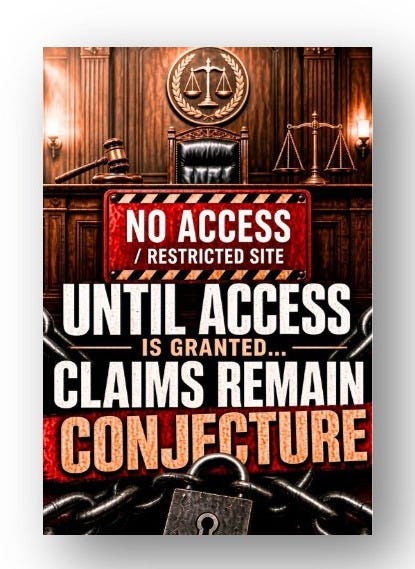
In a courtroom, physical evidence of the June 21–22, 2025 strikes is admissible and strong. The absence of independent, on-site examination of the residual highly enriched uranium and the damaged facilities prevents a high-confidence finding of permanent elimination.
When the subject of the investigation controls the sites and refuses proper inspection, further claims about residual capacity or recovery timelines become conjecture until access is granted.
“Test everything; hold fast what is good.”
1 Thessalonians 5:21
That is why it is fair to say he stopped Iran from using a nuclear bomb on day one. Not because inspectors signed off. Because the country has been pulverized. The top of the regime is gone, and still no nuclear weapon has been used. If they had a working bomb and meant to use it, this war was the time. They went after ships instead.
The first aim was to stop a nuclear bomb. After Iran started shooting at ships, the fight became about oil. That was Iran’s choice. It was not President Trump’s first target.
He did not rush from one strike to the next with no pause. There was an April ceasefire. In June there was another memorandum of understanding. He held back for months while those MOU’s were signed. He said he wanted the strait open and the shooting to stop. The June deal said Iran would use its best efforts to let commercial ships pass safely.
Days later a cargo ship in the strait was hit. The United States said Iran fired drones at ships and broke the ceasefire. Then American aircraft hit Iranian missile and radar sites. Iran said the United States broke the deal. Look at the order. The ship was hit first. That is when the war over oil got worse.
Iran broke those understandings. President Trump did not tear them up on his own and then go hunt tankers. From that point forward, oil was the issue. That was by Iran’s hand.
Why The Conflict Continues
The conflict is continuing because after Iran was decimated by the first Military Strike from The United States,
Iran shifted it’s strategy to the Straight of Hormuz
in order to continue having control.
A second, broader wave of U.S. and Israeli strikes took place in February–March 2026. Despite these actions and subsequent diplomatic efforts, the conflict has not ended. The reasons are concrete and observable.
First, the nuclear file remains incomplete. Without on-site verification, there is no confirmed neutralization or full accounting of that material. As long as this residual capability cannot be independently assessed or resolved, the underlying proliferation concern that drove the strikes continues to exist.
Second, Iran shifted its primary strategic leverage to the Strait of Hormuz. After the nuclear infrastructure was degraded, Tehran elevated control of the waterway—through which a large share of global oil and LNG transit passes—as its preferred instrument of pressure.
Third, the ceasefire and memorandum-of-understanding arrangements reached in mid-2026 have proven fragile. Iranian attacks on shipping and U.S.-linked targets in the region have repeatedly tested the truce. The United States has responded with retaliatory strikes on Iranian military assets near the strait. Each cycle of action and response has prevented the conflict from fully closing.
The war continues because two core issues remain unresolved: the unverified residual nuclear material that Iran will not allow to be properly inspected, and Iran’s ongoing efforts to convert the Strait of Hormuz into a permanent strategic pressure point.

Oil Is Priced In A Global Market
If Iran maintained effective, lasting control of the Strait of Hormuz — the ability to restrict, toll, or close transit at will — the adverse effects on the United States would be serious.
Prior to the recent conflict, approximately 20 million barrels per day of crude oil and petroleum products moved through the strait, representing roughly 20 percent of global petroleum liquids consumption and about 25 percent of seaborne oil trade.
Oil is priced in a global market. Even though the United States is a major domestic producer, sustained restriction of Hormuz flows drives world prices higher and those increases reach American consumers through gasoline, diesel, and related costs.
This is not theoretical. When transit through the strait is restricted or threatened, global crude prices rise and U.S. gasoline prices follow.
Under the Biden administration (2021–January 2025) the national average price of regular gasoline rose from approximately $2.40 at the start of the term to a peak above $5.00 per gallon in June 2022 following the Russian invasion of Ukraine. Annual averages ran roughly $3.01 in 2021, $3.95–$3.97 in 2022, $3.51–$3.53 in 2023, and $3.30–$3.42 in 2024.
In the early months of the second Trump term, prices began near $3.10 and declined toward the high $2 range by early 2026. Following the escalation with Iran that began in late February 2026, national averages rose sharply, reaching peaks above $4.50 in May 2026 before partially easing with diplomatic efforts. Prices have remained elevated relative to the pre-conflict period.
Gasoline prices in the United States respond primarily to global crude supply, demand, and geopolitical risk rather than to any single administration’s domestic policy alone.
What Are The Ramification of What Happened Last Week
Gas Prices In This Country Also Move When Other Countries Fight.
Last week President Trump told President Zelensky to stop knocking out diesel fuel in Russia.
Ukraine has been hitting Russian refineries for months. Russia answered by banning diesel exports. Russia was one of the world’s largest diesel sellers. When those plants go down, less diesel hits the world market. U.S. diesel is now $6.51 a gallon, a record.
Patrick De Haan at GasBuddy said about 60 to 65 percent of the recent diesel spike comes from those Ukrainian strikes on Russian plants. The rest, he said, is the Iran war and the Strait of Hormuz.
Zelenskyy has not agreed to stop. He said Ukraine will halt strikes on Russian energy only if Russia stops hitting Ukraine’s energy and if the United States can guarantee it. So those attacks are still part of the price.
This is not the first time foreign wars moved the American pump.
In 1973 Arab producers cut oil to the United States and prices jumped.
In 1990 Iraq invaded Kuwait and prices jumped again.
In 2022 Russia invaded Ukraine and diesel and gasoline rose here.
OPEC has cut output when it wanted a higher price.
Houthi attacks in the Red Sea and damage to Saudi Arabia’s East-West pipeline have also taken barrels off the water this year.
This Weekend It Got Closer To The Saudi Capital.
Iran-backed Houthis fired a ballistic missile toward Riyadh. The Saudi-led coalition said it intercepted the missile. Residents heard explosions. Smoke rose near the airport.
There was a fire at an Aramco fuel tank by King Khalid International Airport. The Houthis also said they hit Aramco facilities in Yanbu. Yanbu is where the East-West pipeline meets the Red Sea. That pipeline is one of the main ways Saudi oil gets out when the Strait of Hormuz is a problem.
President Trump cut short a Camp David weekend and went back to the White House. The State Department warned Americans in the region that this fight can escalate fast. Markets moved.
Crude ticked higher on the news. President Trump does not control those events. If Saudi export routes take another hit, the pump here will feel it.
Add it up. Iran and the strait. Ukraine and Russian diesel plants. Russia’s export ban. Pipeline and Red Sea attacks. A missile aimed at Riyadh. They still show up in the $4.48 and the $6.51.
Venezuela
There is one move that points the other way. In January U.S. forces captured Nicolás Maduro. In late August President Trump announced an oil agreement with Venezuela’s interim government. The White House called it the biggest oil deal in history.
It covers about 65 billion barrels of proven reserves. American companies are signing new work. Chevron said it will put in more than $7 billion and more than double its production there over five years. Energy Secretary Chris Wright said output there could more than double in the next few years.
Will that change the course in a positive way? Over time, more oil from our own hemisphere can help. Venezuelan crude is the heavy grade many U.S. Gulf Coast plants are built to run. The deal also gives Washington a right to buy a share at cost, including for the Strategic Petroleum Reserve.
It will not cut the price this week. Venezuela now pumps a little over a million barrels a day. The strait used to carry about 20 million. Analysts have already said this deal will not bring relief at the pump in the near term. Plants here are already running near full. New wells and repaired fields take years, not days.
Venezuela is a long-term plus if the oil actually flows. It is not the reason a gallon is $4.48 this morning. Iran, Russia, Ukraine, and the shipping lanes are.
The Numbers
AAA’s national average for regular gasoline on Sunday, September 20, 2026, is $4.4761 a gallon. Mid-grade is $4.97. Premium is $5.36. Diesel is $6.5050. AAA lists that diesel price as the highest national diesel average it has recorded.
A year ago the national regular average was $3.19. A month ago it was $4.10. A week ago it was $4.31. Prices are still going up.
On Inauguration Day, January 20, 2025, AAA had regular at $3.125. Twenty months later it is $4.48. That is about $1.35 higher, not lower. A 15-gallon fill-up is about $67 today. On Inauguration Day it was about $47. At $2 it would have been $30.
A year ago national diesel was $3.70. Today it is $6.51. When diesel goes up, shipping costs go up. That hits groceries, school buses, and farm work.
In 2024 President Trump said energy costs — air conditioning, heating, gasoline — would drop by more than 50 percent in the first 12 months. He also said it could take 18 months. He said $1.87 was a beautiful number from his first term. Half of $3.13 is about $1.56. The 12 months passed. So did the 18 months. The price did not go there.
Gas prices went up and down. They fell in late 2025 and early 2026. Then the Iran war sent crude near $100 a barrel. After the fighting he changed the target to $2.30, then $3, then $2.50. Prices did not fall to those new targets either. Labor Day 2026 was the most expensive Labor Day average on record, near $4.15. Two weeks later the national average is $4.48.
The Other Road
Doing Nothing Has A Price As Well.
If Iran controls that waterway, the price is not only today’s $4.48. It is Iran setting the terms the next time it wants something.
People Can Blame The President for $4.48 Gas Prices.
BUT they should also say which future they want.
A hard fight to keep the strait open.
Or Iran with a hand on the world’s oil.
Promise: gasoline below $2. Today: $4.48 national. Promise: energy costs cut in half in 12 months, 18 at most. Today: regular is up about 43 percent from Inauguration Day. Diesel went from $3.63 that week to $6.51 now.
People can hold him to the $2 promise. They should. He said it.
What they cannot do is pretend a president can walk into a station
and order gas prices to be reduced.
This Did Not Start At The Pump. It Started With The Bomb.
Iran moved it to oil.
Other countries piled on.
That is why a gallon is $4.48 this morning.
Blame him for the promise if you want. Then say which road you would have taken.
If you found this interesting, share Higher Ground News with others
Share this article with others.
Share Higher Ground News with others.